


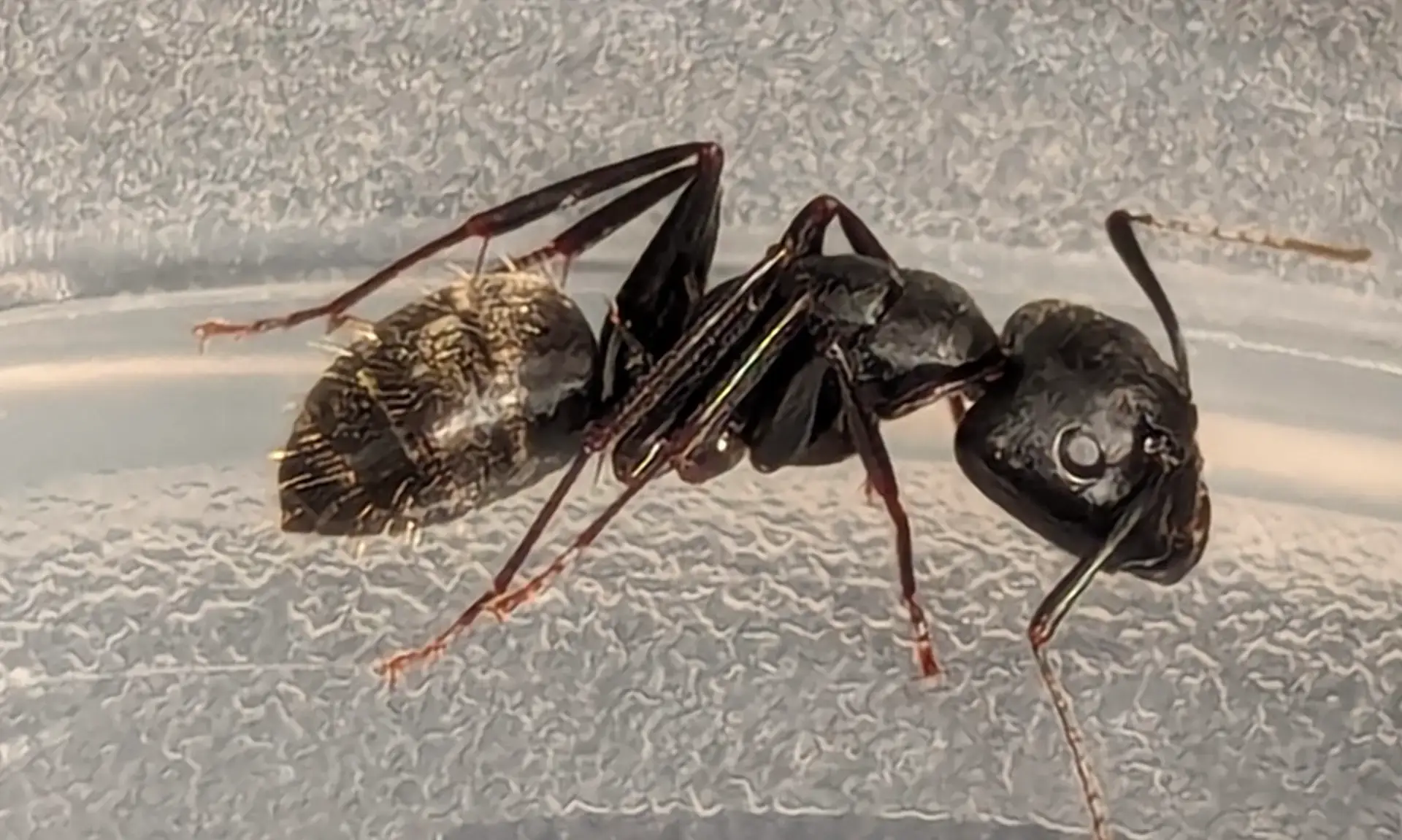
They’re everywhere. In your garden, under your driveway, probably within ten feet of you right now. You’ve stepped on thousands of them without a second thought. But what if we told you that ants are, pound for pound, among the most extraordinary creatures to ever walk the earth? Prepare to look down … and be astonished.
1. The Surgeons Without Scalpels: Ants as Living Sutures
Long before humans invented surgical staples, stitches, or even the concept of sterile technique, ancient healers had already solved the problem of closing a wound. Their solution? Ants.
Across cultures separated by oceans; from the indigenous peoples of the Amazon to ancient healers in India, the Middle East, and sub-Saharan Africa, a remarkably consistent medical practice emerged. When a wound needed closing, a large-jawed ant (often a driver ant or army ant) was held over the gash. The ant, reacting instinctively to the threat, bit down hard, driving its mandibles through both sides of the wound and pulling the edges together. Then came the decisive moment: the healer would twist or snap off the ant’s body, leaving only the head (mandibles still locked, still clenching) embedded in the skin as a living, biodegradable staple.
The head would remain in place for days, holding the wound shut while healing began underneath. When it was time to remove it, the head was simply plucked free.
What’s astonishing isn’t just the ingenuity of the healers who discovered this technique — it’s that the ants were perfect for the job. Species like the driver ant possess mandibles strong enough to pierce tough jungle-hardened skin and maintain grip through trauma, movement, and moisture. No slipping. No loosening. They held fast.
This wasn’t primitive desperation. It was elegant bioengineering, discovered independently by multiple civilizations, standing the test of thousands of years. Modern surgeons still use metal staples that work on the exact same mechanical principle.

2. The Stomach That Belongs to the Colony
You have one stomach. You eat, you digest, you’re done. Your transaction is between you and your meal. Ants operate on an entirely different philosophy. Many species have two stomachs, and only one of them belongs to the ant itself.
The second stomach called the social stomach or crop is a communal reservoir. An ant that finds food doesn’t simply eat and move on. Instead, it fills this social stomach and carries the meal home to share. Back at the colony, a remarkable process called trophallaxis unfolds: the forager regurgitates food mouth-to-mouth directly into the waiting mouths of nest-mates who never left home such as nurses, larvae, soldiers, and even the queen.
This isn’t just generosity. It’s a sophisticated biological distribution system. Through trophallaxis, a single forager can feed a dozen nest mates in minutes. The colony, in effect, operates as a single metabolic unit a super organism where nutrients flow through the collective body like blood through veins.
But here’s where it gets stranger. Scientists have discovered that trophallaxis doesn’t just distribute food. It distributes information. The shared fluid contains chemical signals in the form of pheromones and other compounds — that communicate the colony’s nutritional status, the age and role of nestmates, reproductive cues, and potentially even behavioral instructions. Every meal is also a conversation.
Two stomachs. One for the individual. One for the colony. Ants figured out shared resources long before humans invented the word community.
3. Farmers Before Farmers Existed
Somewhere in the tropical forests of South America, roughly 60 million years ago, long before any human set foot on Earth, a lineage of ants invented agriculture.
Leafcutter ants are perhaps the most famous example, but the story of ant farming runs far deeper and stranger than that. Across dozens of ant species worldwide, a sophisticated relationship with aphids has evolved that looks, to any honest observer, exactly like livestock management.
Aphids feed on plant sap and excrete a sweet, nutrient-rich liquid called honeydew. Ants discovered this. Then, over evolutionary time, they exploited it. They domesticated them.
Ant farmers stroke aphids with their antennae to stimulate honeydew production, essentially “milking” them on demand. They protect their herds from predators like ladybugs, often fighting off attackers that are many times their size. Some species have been observed carrying aphids to new, more productive plants when the current food source runs out effectively ranching them across the landscape. Others have been documented bringing aphid eggs inside the nest during winter to keep them safe, then carrying the newly hatched aphids back to plants in spring.
There’s a darker chapter too. Some ant species produce chemicals that chemically suppress the wings of aphids, preventing them from flying away. The aphids are captives like livestock that has been, over millions of years of co-evolution, gradually stripped of its ability to escape.
Humanity has been farming for about 12,000 years. Ants have been doing it for 60 million. They were running agricultural operations before the dinosaurs were gone.
4. They Hear the World Through the Ground
Close your eyes and listen. The rustling of leaves, the ambient hum of the world, and the sound of your own breathing . You experience sound the way most mammals do, through air pressure waves that strike your eardrums and translate into sensation. Ants experience almost none of this.
They are, in every practical sense, deaf to the airborne world.
Instead, ants hear through their feet.
Specialized structures in their legs called subgenual organs that detect minute vibrations traveling through solid surfaces. The ground, a leaf, a twig, a rock: these are all acoustic channels through which ants receive information. A nestmate in distress, scraping an organ on its body to produce a distress signal. The rhythmic drumming of a queen communicating status. The faint tremors of a predator’s approaching footsteps.
This form of hearing, called substrate-borne vibration detection, is extraordinarily precise. Research has shown that some ant species can distinguish between vibration patterns produced by their own queens versus those produced by parasitic beetles that have infiltrated the colony, and they react with dramatically different behaviors to each. They are sensing more than movement. They are listening with their legs, decoding complex signals from the physical world around them.
The next time you’re near an ant trail, try tapping your finger on the surface near them. Watch what happens. You haven’t made a sound they can “hear“ the way you can. But you’ve just shouted at them.
5. The Sting That Rewrites Your Understanding of Pain
On the Schmidt Sting Pain Index, a scale developed by entomologist Justin Schmidt, who bravely allowed himself to be stung by dozens of insect species in the name of science, most stings fall in the lower ranges. A honeybee sting is a 2. A paper wasp, a 3. And then there is the bullet ant, sitting alone at the very top: a 4, described in Schmidt’s own words as “pure, intense, brilliant pain. Like walking over flaming charcoal with a 3-inch nail embedded in your heel.”
The bullet ant (Paraponera clavata) is a large, slow-moving species native to the rainforests of Central and South America, named not for its appearance but for what its sting feels like… a gunshot. The venom contains a unique neurotoxin called poneratoxin, which disrupts normal nerve signal transmission and causes uncontrolled, sustained firing of pain neurons. There is no fooling the body. There is no “pushing through it.” The pain is total, overwhelming, and lasts for up to 24 hours without significant diminishing.
Perhaps the most staggering thing about bullet ant venom is that it has been deliberately chosen as an instrument of ritual. Young men of the Sateré-Mawé tribe in Brazil weave hundreds of living bullet ants into woven gloves — stingers facing inward — and must wear them for ten full minutes as a rite of passage into adulthood. The ceremony is repeated twenty times over months or years before a young man is considered a warrior.
The ants aren’t doing anything unusual. They’re just defending themselves. The fact that their defense mechanism is one of the most excruciating biological experiences a human body can endure is simply what evolution built.
6. The Zombie Masters of the Forest Floor
There are horror stories. And then there is Ophiocordyceps unilateralis.
This parasitic fungus targets carpenter ants with a specificity that seems almost calculated. When a spore lands on an ant and penetrates its exoskeleton, the fungus begins growing… not just through the body, but into the brain. Over the course of days, it hijacks the ant’s behavior with terrifying precision. The infected ant abandons its colony, stumbles away from its familiar trails, and begins climbing. Up a stem, up a leaf, up whatever vertical surface is nearby. Then, at a very specific height, typically between 25 and 30 centimeters above the forest floor, where temperature and humidity are optimal for fungal growth, the ant clamps its mandibles around the central vein of a leaf with incredible, locked force (the same force inspiring early medical suture use).
And then it dies. And the fungus blooms from its head, releasing spores to infect the next victim below.
What makes this phenomenon so deeply unsettling to scientists goes beyond manipulation to the precision. The fungus doesn’t just make ants climb any random distnace. It makes them climb to exactly the right height. It positions them on the underside of leaves. It times the death to maximize spore dispersal. The ant, in its final hours, has become an instrument of something else’s reproduction.
Some ant colonies have been observed essentially quarantining infected nest mates, carrying them far from the nest before the final climb begins, suggesting an evolutionary arms race older than human civilization.
7. The Living Raft: Engineering Without an Engineer
When floodwaters rise in the Amazon basin, fire ants face a choice that isn’t really a choice: drown, or build something extraordinary.
They build a raft.
Fire ants in flooded conditions will link their bodies together; latching legs, mandibles, and bodies into a self-assembling mat of thousands of individuals. The physics are counterintuitive but real: the ants trap air bubbles in the structure, and their waxy, hydrophobic bodies create enough surface tension to stay afloat as a collective. Individual ants submerged beneath the raft can survive for hours, cycling through the structure as the colony redistributes itself.
What makes this phenomenon remarkable is that there is no architect. No ant surveyed the flood and drew up plans. The behavior emerges spontaneously from simple individual rules: hold on to a nestmate, move to a position that keeps the raft stable, keep the queen toward the center. Complex, self-reinforcing, adaptive behavior arising from simplicity. This is what scientists call emergence.
These rafts can survive for days or weeks. They can travel miles downstream, still intact, and establish new colonies wherever they make landfall. A flood that would kill isolated individuals becomes, for the collective, a dispersal mechanism.
The raft doesn’t just save the colony. It spreads it.
8. She Will Outlive Your Dog, Your Cat, and Possibly You
Insects are supposed to be ephemeral. A mayfly lives for a day. A housefly, a few weeks. And then there are ant queens.
The queen of a harvester ant colony has a verified lifespan of up to 30 years making her one of the longest-lived insects ever documented. Some queen species are suspected to live even longer. Workers, by comparison, live months to a few years, but they are replaceable. The queen is not. She is the reproductive engine of the entire colony, laying thousands of eggs per day, sometimes sustained for decades without a break in productivity.
Worker ants in most species are entirely female (daughters of the queen), reproductively suppressed by pheromones the queen constantly releases. The males, by contrast, exist for one purpose: a single mating flight. They mate, and then they die. Their entire existence is measured in days.
The disparity in lifespan between queen and worker isn’t a biological mystery — it’s a design principle. The colony’s survival depends on continuous reproduction from a tested, established queen. Her body reflects that priority: she is physiologically distinct from her daughters, larger, with a fat body dedicated to sustaining reproduction rather than foraging or fighting.
A colony with a thriving 25-year-old queen isn’t a collection of insects. It is, in every meaningful sense, a living institution.
9. Pound for Pound, the Strongest Animal on Earth
Pick up a bag of rice. Now imagine carrying fifty of them. Now imagine doing that while climbing a vertical wall.
Leafcutter ants routinely carry fragments of leaves that weigh up to 50 times their own body weight, and they do it while navigating complex terrain, maintaining precise trails, and doing so for hours at a time. Some species have been recorded carrying objects 100 times their body mass for short bursts. In proportion to their size, no vertebrate animal comes close.
The secret lies in their musculature. Ant bodies dedicate a dramatically higher proportion of their internal volume to muscle, particularly in the head and thorax, than any vertebrate could afford. A human-sized ant would be capable of strength that would make any Olympic weightlifter look feeble by comparison. (Fortunately, physics works against the hypothetical giant ant in other ways, but the muscle density is real.)
What’s equally remarkable is the control. These aren’t brute force lifters. Leafcutter ants carrying large fragments must constantly adjust their load, compensate for wind, navigate obstacles, and fit through narrow tunnels all while the load blocks their forward view. In extended tests, ants carrying difficult loads have been observed cutting their fragment into a smaller size to make it more manageable. This is a problem-solving behavior that implies something closer to decision making than pure instinct.

10. The Supercolony: One Nation, Billions of Ants, Thousands of Miles Wide
Every rule has an exception. The rule that ant colonies are closed societies (where any outsider is detected and destroyed) meets its spectacular exception in the Argentine ant (Linepithema humile).
Native to South America but spread across the world through human trade, Argentine ants have formed what scientists believe to be the largest cooperative colony in the history of life on Earth. Along the Mediterranean coast of Europe, a single interconnected supercolony stretches for 6,000 kilometers — from the Atlantic coast of Portugal to the Italian Riviera. Billions of workers. Millions of queens. All of them, genetically and chemically, recognizing one another as family.
Argentine ants from Portugal will not fight Argentine ants from France. Bring them together in a lab, and they groom each other. They share food. They behave as nestmates, despite having never met, because they share the same chemical signatures.
This has made them devastatingly successful invaders. Most ant species spend enormous energy fighting neighboring colonies. The Argentine supercolony simply… doesn’t. Its borders are open. Its resources are shared. Where other species fracture into competing factions, the supercolony expands as a unified front.
Scientists describe it as one of the most ecologically dominant phenomena they’ve observed in modern times. It is, in a very real sense, it is more than a colony. It is a civilization.
The World Beneath Your Feet
The next time you pause on a sidewalk and watch a line of ants work their purposeful way across the concrete, remember: you’re looking at surgeons, farmers, engineers, and architects. You’re looking at creatures older than the continents in their current shape, that have outlasted mass extinctions, that farm, communicate, coordinate, sacrifice, and survive with an efficiency that still humbles modern scientists.
They’re tiny. But they are, by almost any meaningful measure, the most successful animals on Earth.
Maybe we should look down more often.
start your environmentally conscious pest prescription today
Learning about ants is fun, but nature should stay in nature and out of your home. Schedule an inspection with the EnviRx Pest Solutions team today to protect your home, business, and the ones you care about most!
Explore more fascinating facts about the natural world at goenvirx.com.
About Rob Greer: Pest Control Expert and Industry Leader
Rob Greer, founder and CEO of EnviRx Pest Solutions, developed a deep respect for nature growing up in a small rural town, where he raised horses and cattle. He began his career in pest control in 2001 and has spent over two decades building and leading pest control operations across the country.
Rob holds a BS in Business Management and is an Associate Certified Entomologist (ACE), a credential held by a small percentage of pest control professionals nationwide. His contributions to the industry include collaboration on the National Pesticide Applicator Certification Core Manual for the EPA and the QualityPro Customer Service Credential Task Force. He is an active member of the Texas Pest Management Association.
The outskirts of Houston is where Rob ran the trails of Huntsville at the Rocky Raccoon 100, and EnvirX’s leadership team lives and works throughout the greater Houston metro. That on-the-ground familiarity with Gulf Coast pest pressures and what residents actually need is what shaped the EnvirX approach…a prescription-based model that diagnoses root causes rather than just treating symptoms.
Leave a Reply