


Published on GoEnvirX.com | Houston Pest & Health
You already know ticks are unpleasant. You’ve probably done the post-hike shimmy-and-check in the bathroom mirror, or plucked one off your dog with a pair of tweezers and had a mildly dramatic reaction. That’s all fair. Ticks are, by any reasonable measure, the worst.
But there’s a tick-borne illness making national headlines right now that deserves your attention, especially if you live anywhere in the greater Houston area where our lush, humid, Gulf Coast landscape is basically a five-star resort for the little freeloaders.
It’s called Powassan virus, and it is more than your average tick annoyance.
What Is Powassan Virus?
Powassan (pronounced pow-AH-sun, and yes, it does sound a little like a warning) is a rare but increasingly common tick-borne flavivirus (part of the same viral family responsible for tick-borne encephalitis in Europe and Asia). It was first identified in 1958 in Powassan, Ontario, after a child died from encephalitis following a tick bite.
For decades, it was considered so rare it barely made the radar. Then 2025 happened: 76 confirmed cases nationwide which is the highest ever recorded in a single year. For context, there were only 7 reported cases in 2015. That’s nearly an elevenfold increase in a decade.
2026 is already shaping up to be another banner year for ticks in general, with emergency room visits for tick bites up 25 percent over the prior year in some regions. Powassan is riding that wave.
A Few Fast Facts About This Virus
It can transmit in as little as 15 minutes. This is the fact that grabs attention quickly. Unlike Lyme disease, which typically requires a tick to be attached for 24–36 hours before transmission, Powassan can pass from tick to host in under a quarter of an hour. By the time you notice the bite, the job may already be done.
Most people don’t know they have it. Somewhere between 90 and 95 percent of infected people experience either no symptoms at all or only a mild flu-like illness. The body clears it, and they never know what hit them.
But when it goes neurological, it goes fast. In the cases that progress, Powassan can take a detour and invade the central nervous system and cause encephalitis (inflammation of the brain) or meningitis (inflammation of the tissues surrounding the brain and spinal cord).
There is no vaccine. There is no specific treatment. If you develop severe Powassan disease, the medical approach is supportive care: rest, fluids, and hospitalization for the serious cases. Antibiotics don’t work on viruses. You’re waiting it out.
It is the only tick-borne flavivirus found in North America. There’s nothing particularly comforting about being unique in this category.
Signs and Symptoms: What to Watch For
Initial symptoms, when they appear, tend to show up one to four weeks after a tick bite. They include:
- Fever
- Headache
- Vomiting
- Weakness
If the virus moves into the central nervous system, the picture gets more serious:
- Confusion
- Loss of coordination
- Difficulty speaking
- Seizures
About 10 percent of people who develop the neurological form of Powassan disease will die from it. Roughly half of the survivors experience long-term neurological effects such as memory problems, persistent headaches, and difficulty with concentration or speech that can last months or years.
If you’ve been in a tick-prone area and develop a fever with neurological symptoms, especially if you know you had a tick bite, see a doctor and mention it specifically. Powassan is notoriously under-diagnosed in part because many physicians haven’t been trained to look for it. This is further complicated by the similarity in symptoms to so many other diseases.
The Ticks That Carry It (And One Wild Scientific Plot Twist)
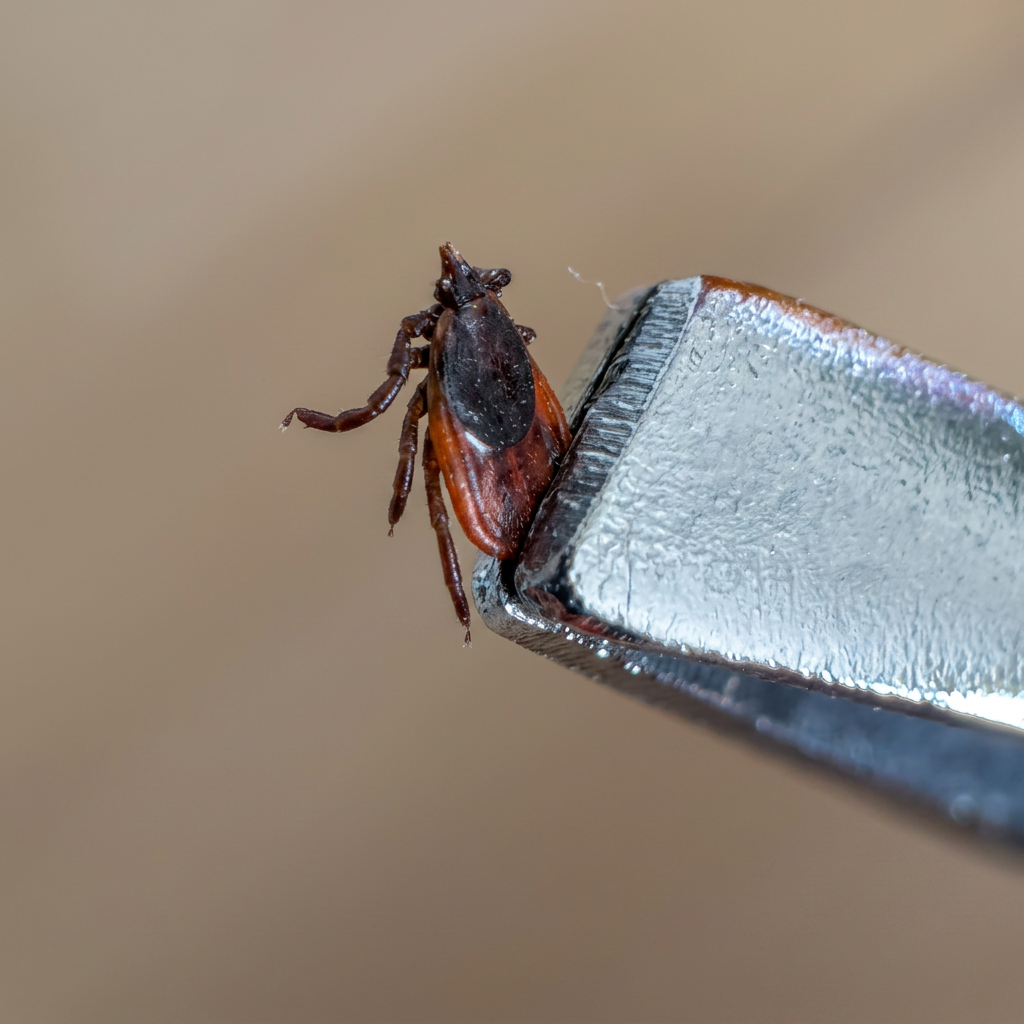
Three tick species are known to transmit Powassan: the groundhog tick (Ixodes cookei), the squirrel tick (Ixodes marxi), and the black-legged tick (also called the deer tick) (Ixodes scapularis). The groundhog and squirrel ticks rarely bite humans. The black-legged tick very much does, and it’s the one responsible for most human Powassan cases.
Here’s what you should know about black-legged ticks:
They are very small. Nymphs, the life stage responsible for many human infections, are roughly the size of a poppy seed. You can absolutely miss one during a tick check if you’re not being meticulous.

They are patient. Black-legged ticks use a behavior called “questing” where they climb to the tips of grasses or low vegetation, extend their front legs, and wait for a warm-blooded host to walk by. They can wait for weeks.
They feed on white-tailed deer as adults. This is why suburban areas with healthy deer populations like your Woodlands trail systems, your neighborhood greenbelts, and the back edge of your Tomball property can all have surprisingly high tick densities.
They carry multiple diseases simultaneously. The same tick can carry Lyme disease, Powassan virus, anaplasmosis, babesiosis, and other pathogens at once. Co-infections are a real and underappreciated complication of tick bites.
But Wait, Can Ticks Actually Fly?
Sort of, kind of, not exactly, but the real answer is more interesting than a flat no.
Ticks cannot jump. They have no wings. For most of scientific history, the assumption was that ticks could only reach a host through direct contact e.g., you brush against the grass where they’re waiting and they cling on.
Then, in 2023, researchers at the University of Bristol published a study that changed the picture somewhat. They discovered that ticks can be passively attracted to hosts through electrostatic charge. This is the same physics behind a balloon sticking to your hair or a sock clinging to the dryer.
It turns out that mammals, birds, and reptiles naturally accumulate electrostatic charges as they move through their environment by rubbing against grass, sand, and other animals. These charges can be surprisingly strong. When a tick is close enough, that electrical field can literally pull it through the air across gaps several millimeters to centimeters wide; distances that, scaled to tick size, represent something equivalent to a human leaping several flights of stairs.
The researchers tested it by placing ticks below a charged electrode with an air gap between them. The ticks were “whooshed” through the air to the charged surface. Charged rabbit fur produced the same effect.
The practical implication: you don’t necessarily have to directly brush against a tick for it to find you. If you’re close enough, your body’s natural electric field may do the recruiting. It’s a very small effect compared to direct contact, but it’s significant, and it’s just another reminder that ticks are disturbingly adantaged.
(Anti-static sprays as a tick prevention tool are now being researched. The future is weird.)
What About Houston? Should We Be Worried?
Here’s the nuanced answer: Powassan cases are currently concentrated in the Northeast and Great Lakes region, where black-legged tick populations are dense. Texas, including the Houston area, is not currently a hotspot for Powassan specifically.
But here’s the important context:
Black-legged ticks are present in Texas and expanding. They’ve historically been less common here than in the Northeast, but surveillance data shows they’re increasingly found in Texas, including wooded areas of East Texas and Harris County. The black-legged tick is the primary Powassan vector, and its range is shifting.
Houston is already prime tick territory. The two most common ticks in this area are the Lone Star tick and the Gulf Coast tick; both of which bite humans aggressively and carry their own suite of serious diseases including ehrlichiosis, Rocky Mountain spotted fever, tularemia, and the alpha-gal syndrome (the one that can give you a red meat allergy, which is perhaps the cruelest thing a tick has ever done to a Texan).
Our climate keeps them active year-round. In most of the country, ticks slow down significantly in winter. In Houston? Our mild winters mean ticks can remain active through most of the year, particularly during warm spells. There is no real “off-season” for tick awareness here.
The trend lines are moving in the wrong direction. More tick encounters, more tick-borne disease generally, and expanding ranges for species like the black-legged tick mean the risk picture for Houston is evolving. The time to start paying attention to Powassan is not after it arrives at your doorstep.
How to Protect Yourself When You’re Out and About
The good news is that the prevention strategies for Powassan are the same ones that protect against all tick-borne illness. None of them are complicated. Some of them you’ve probably already heard but haven’t quite put into practice.
Dress the part. Wear long pants tucked into your socks, long sleeves, and light-colored clothing (so you can actually spot a poppy-seed-sized nymph against the fabric). It feels less stylish than shorts. It is considerably preferable to brain inflammation.
Use repellent, and use the right kind. EPA-registered repellents containing DEET, picaridin, or oil of lemon eucalyptus work well on skin. For clothing and gear, permethrin is the gold standard as it remains effective through multiple washes and kills ticks on contact. These two used together offer excellent protection.
Do a full-body tick check after every outing. Go beyond a quick once-over. A real check: behind the ears, on the scalp, in the hairline, behind the knees, at the waistline, in the armpits, and between the toes. Enlist a helper if necessary. Nymphs especially like warm, hidden spots.
Shower within two hours of coming indoors. Showering washes off unattached ticks and gives you another opportunity to find any that have started to wander. Tumbling dry clothes on high heat for 10 minutes kills ticks that survived the outdoors.
Remove a tick correctly. Fine-tipped tweezers, grasped as close to the skin surface as possible, steady upward pressure. No twisting, no burning, no petroleum jelly. Twisting or dousing a tick can cause it to regurgitate into the bite site, which is exactly as bad as it sounds from a disease-transmission standpoint.
Know your timeline. Given that Powassan can transmit in 15 minutes, prompt removal matters enormously. Check early and often during outdoor activities, not just after.
Keeping Tick Populations Low in Your Own Yard
Here’s the thing: you don’t have to venture into Sam Houston National Forest to get a tick bite. A significant percentage of tick exposures happen right in people’s own backyards during gardening, yard work, or just letting the dog out.
The good news is that a few straightforward changes to your yard can make it dramatically less hospitable to ticks:
Keep the grass mowed. Ticks prefer to quest in taller vegetation. A well-maintained lawn (grass kept to 3 inches or below) removes a lot of the habitat they depend on.
Address the border zones. The transition areas between your maintained lawn and wooded edges, brush piles, or overgrown vegetation are tick hotspots. Keep these edges trimmed, and consider a 3-foot barrier of wood chips or gravel between your lawn and any wooded areas to discourage tick migration.
Remove leaf litter and debris. Ticks thrive in moist, shaded environments with plenty of organic cover. Piles of leaves, brush, and debris along fence lines and under shrubs are basically tick condominiums. Remove them, especially in the fall.
Stack woodpiles neatly in sunny locations. Away from the house, in the sun. Ticks dislike dry, warm conditions, and so do the rodents that carry ticks between life stages.
Manage wildlife access to your yard. Deer, raccoons, opossums, and mice are the primary vehicles by which ticks arrive on your property in the first place. Deer-proof fencing where practical, secure garbage to reduce wildlife attraction, and consider landscaping choices that are less appealing to deer.
Check your pets every time they come inside. Dogs especially can bring ticks in from the backyard and deposit them on your furniture, carpeting, and eventually on you. Vet-recommended tick preventatives for pets are a worthwhile investment.
A Word About Professional Tick Control
If your yard backs up to wooded areas, greenbelts, or open fields (or if you’re in one of our suburban Houston communities where deer are as common as neighbors) DIY prevention measures alone may not keep tick populations at a manageable level.
This is where a professional inspection can genuinely help. The EnviRx team can assess your specific property for tick habitat risk factors and walk you through control options including targeted barrier treatments around yard perimeters and the areas where people and pets spend time, as well as integrated approaches that address the wildlife and rodent activity that sustains tick populations in the first place.
Our approach isn’t to saturate your yard with chemicals and call it a day. It’s to understand what’s actually driving the pest pressure on your specific property and build a plan around that. If you’re curious about what tick activity looks like on your property (or you want to get ahead of a problem rather than react to one) give us a call for an inspection. We’re in your neighborhood.
The Bottom Line
Powassan virus is not a reason to panic; just a reminder to pay attention.
Cases are rare. Most people who get it don’t even know. But when it progresses, it progresses seriously, and the 15-minute transmission window means your normal “I’ll check when I get home” approach isn’t sufficient protection if you’re spending time in tick-heavy areas.
The Houston area isn’t a Powassan hotspot today. But ticks are here, they’re active most of the year, they carry a menu of other diseases that deserve respect, and the national trend lines for tick-borne illness are moving consistently upward.
Be aware, do your tick checks, treat your clothing, manage your yard, and if you find a tick on yourself or a family member and develop fever or neurological symptoms in the following month, mention the tick bite to your doctor specifically.
The tick didn’t ask for your informed vigilance. But it’s worth giving it anyway.
Got questions about tick activity around your home? Explore EnviRx’s protection plans or schedule an inspection at goenvirx.com.
About Rob Greer: Pest Control Expert and Industry Leader
Rob Greer, founder and CEO of EnvirX Pest Solutions, developed a deep respect for nature growing up in a small rural town, where he raised horses and cattle. He began his career in pest control in 2001 and has spent over two decades building and leading pest control operations across the country.
Rob holds a BS in Business Management and is an Associate Certified Entomologist (ACE), a credential held by a small percentage of pest control professionals nationwide. His contributions to the industry include collaboration on the National Pesticide Applicator Certification Core Manual for the EPA and the QualityPro Customer Service Credential Task Force. He is an active member of the Texas Pest Management Association.
The outskirts of Houston is where Rob ran the trails of Huntsville at the Rocky Raccoon 100, and EnvirX’s leadership team lives and works throughout the greater Houston metro. That on-the-ground familiarity with Gulf Coast pest pressures and what residents actually need is what shaped the EnvirX approach…a prescription-based model that diagnoses root causes rather than just treating symptoms.
Leave a Reply