


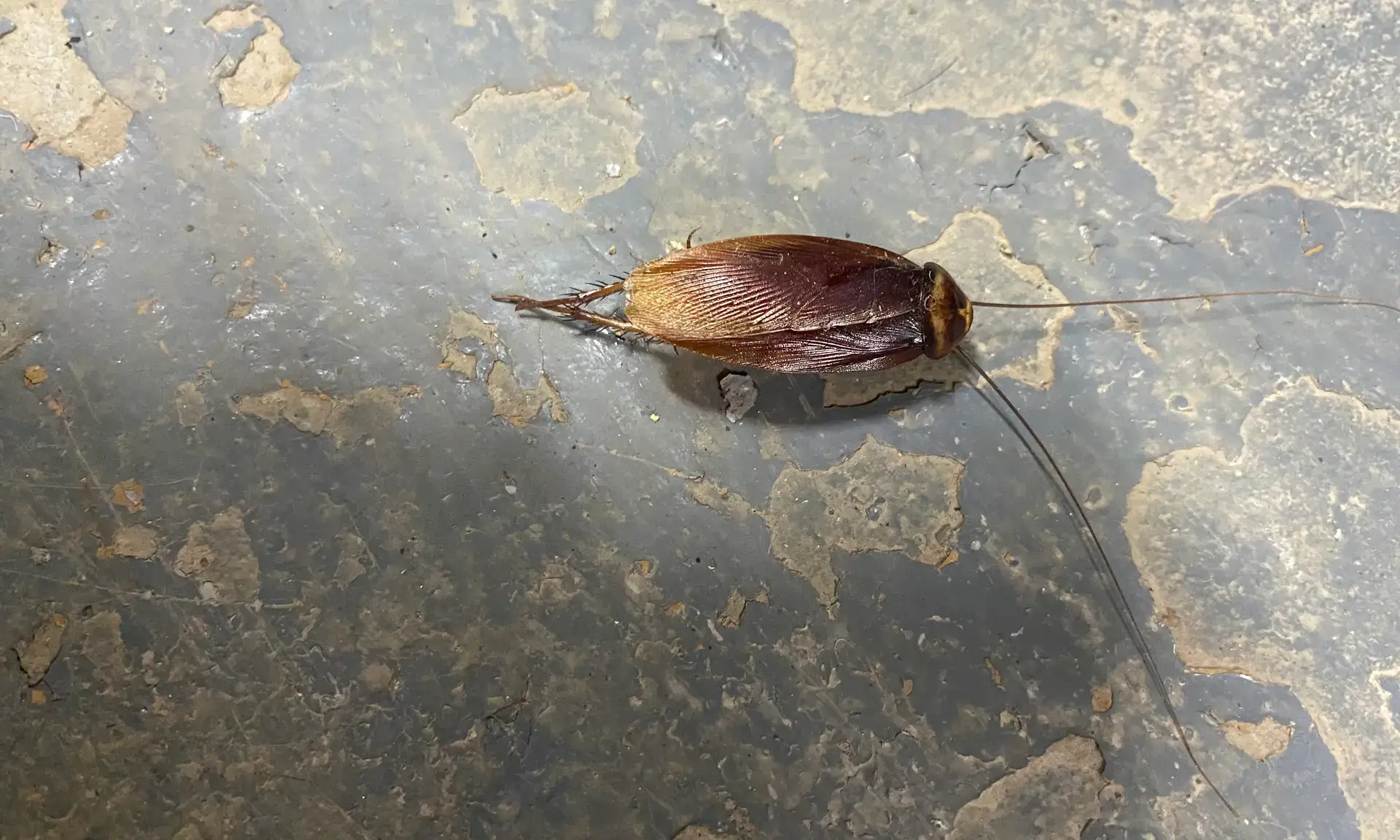
Let’s be honest: nobody outside of our associate certified entomologist has ever screamed with joy at the sight of a cockroach skittering across the kitchen floor. They’re the universal symbol of “gross.” Grab a shoe, kill it, question your life choices. That’s the cockroach experience for most of us.
But here’s the plot twist for cockroach haters: the same qualities that make cockroaches nightmare fuel such as their toughness, their size, and their ability to survive absolutely anything, are exactly why scientists around the world keep finding new jobs for them. Think:
- bomb detection
- earthquake rescue
- sustainable protein
- even “milk.” (We’re not making this up.)
So pull up a chair (check it for roaches first, just kidding … mostly) and let’s talk about why one of the most hated bugs on the planet might also be one of the most useful behind the scenes.

Super Insect powers
Before we get into the wild applications, it helps to understand why cockroaches keep getting picked for these jobs in the first place. They’re basically nature’s tiny tanks: they can withstand forces roughly 1,000 times their own body weight, squeeze through gaps a fraction of their height, run several body-lengths per second, and shrug off environments that would take out most other creatures. They’ve outlived multiple mass extinctions. A robot engineer spends years and millions of dollars trying to build something with that kind of resilience. Cockroaches show up to work already built that way, and they run on a few crumbs instead of a battery pack.
That combination of rugged, cheap, self-powered, and small enough to go where nothing else can is exactly why researchers keep turning cockroaches into what’s known as “cyborg insects”: living roaches fitted with tiny electronic backpacks that let a human operator (or an AI) guide their movement.
Roaches to the Rescue: Search and Disaster Response
This is a genuinely remarkable cockroach achievment. After the 2011 Tōhoku earthquake in Japan, researcher Hirotaka Sato watched search-and-rescue teams struggle to reach survivors trapped in collapsed buildings, and set out to build something that could go where rescuers and robots couldn’t. That work eventually led to cyborg cockroaches equipped with lightweight electronic controllers, and versions of the technology were reportedly used during search-and-rescue efforts after the devastating 2025 Myanmar earthquake.
Since then, the field has moved fast. Researchers at Nanyang Technological University in Singapore and Waseda University in Japan recently unveiled something akin to science fiction: a tiny diving suit for cockroaches. The flexible, oxygen-generating suit lets a Madagascar hissing cockroach breathe and move underwater or in low-oxygen spaces for up to three hours, turning a land-based crawler into an amphibious rescue scout that can handle flooded rubble, blocked drains, and submerged tunnels, going where human and robot cannot.
Meanwhile, biorobotics researchers at the University of Queensland and University of New South Wales have taken things a step further with what they call “Paraborgs”: giant burrowing cockroaches fitted with cameras and miniature injectors, designed to reach people trapped in collapsed buildings or caves and deliver emergency medical care under human supervision. In proof-of-concept testing, the roaches hit a 95% success rate on close-range injections. As one of the researchers put it, a lot of people aren’t going to love the sight of a giant cockroach scurrying toward them for help, but if you’re the one stuck under the rubble, you’ll probably take it.
Other teams are even working on AI systems that “listen” to a cockroach’s own heartbeat and nerve signals rather than just issuing commands, aiming for a more cooperative form of control that could make these missions more reliable in the field.
Bomb-Sniffing Bugs
Cockroaches’ cousins in the insect world have also been drafted for a job you wouldn’t expect: explosives detection. Researchers at Washington University in St. Louis, funded by the U.S. Office of Naval Research, discovered they could implant tiny electrodes into a locust’s brain and read its neural activity as it sniffed out compounds like TNT, RDX, and ammonium nitrate. They are capable of distinguishing between different explosives in a fraction of a second. Put a handful of these bio-sensors together and their combined accuracy jumps dramatically compared to using just one.
It’s part of a decades-long DARPA effort exploring cyborg insects (cockroaches very much included) as living, self-powered alternatives to bomb-sniffing dogs and expensive mechanical sensors. Insects don’t need years of training, they’re cheap to deploy at scale, and unlike a robot, nobody has to worry about the battery dying halfway through the search.
Tiny Scouts, Big Data
Beyond rescue and detection, cyborg cockroaches are being explored as mobile information-gatherers for hazardous environments generally: mapping unstable terrain, monitoring air quality and temperature, and relaying video or sensor data from spaces too dangerous or too small for a person to enter. A cockroach doesn’t care if the ceiling might collapse or the air is unbreathable for a human. On our end, we just needs a working data connection.
Piloting the Unpilotable: Robotic Control
How do you actually “drive” a cockroach? Most systems attach a lightweight backpack to the insect’s back that connects to its antennae or nervous system. Small electrical pulses nudge the roach left, right, or forward, essentially hijacking its own navigation instincts rather than fighting against them. The cockroach still relies on its natural reflexes to climb over debris or recover from a fall, which is something engineers have never quite managed to replicate in a fully mechanical robot at this scale. The tech is only active when needed and can be removed once a mission wraps up, and the insects reportedly go on to live out a normal cockroach lifespan afterward.
Wait, We Eat Them Too?
Here’s where “why we love cockroaches” gets a very literal answer. In parts of China, cockroach farming has quietly grown into a sizable industry. Massive facilities with some housing over a billion insects feed roaches on restaurant food scraps, turning tens of tons of daily kitchen waste into a protein-rich resource. The processed insects are ground into animal feed for pigs, poultry, and fish, used in traditional Chinese medicine, and in some regions, eaten directly as a crunchy, protein-packed street food.
The pitch is straightforward: cockroaches convert waste into protein far more efficiently than raising cattle or pigs from scratch, using less land, less water, and producing fewer emissions along the way. As the world looks for more sustainable ways to feed a growing population, insect farming keeps coming up as a serious option. Cockroaches, with their fast breeding and low-maintenance appetite for literally anything, are near the top of the list.
And then there’s cockroach milk. Yes, that’s a real thing. One species, the Madagascar hissing cockroach gives birth to live young rather than laying eggs, and it nourishes its babies with a protein crystal secretion inside its body. Scientists who’ve studied it found it’s remarkably calorie-dense and nutritionally complete, containing all nine essential amino acids. Don’t expect to find it in a gallon jug at the grocery store. Extracting even a small amount requires an impractical number of cockroaches, but it’s a fascinating example of nature already solving problems we’re still trying to engineer our way around.

The Roach Renaissance
None of this is to say you should let the next cockroach you see at home stick around since house infestations are a real problem, and the wild specimens crossing your kitchen counter aren’t the same carefully bred, sanitized ones doing search-and-rescue work in a lab. But it’s worth appreciating the irony: an animal we’ve spent generations trying to eliminate turns out to be one of evolution’s most quietly brilliant designs, and researchers are just now starting to put that design to use for genuinely good reasons such as saving lives after disasters, detecting explosives, feeding livestock more sustainably, and maybe, someday, feeding us.
Leave a Reply