


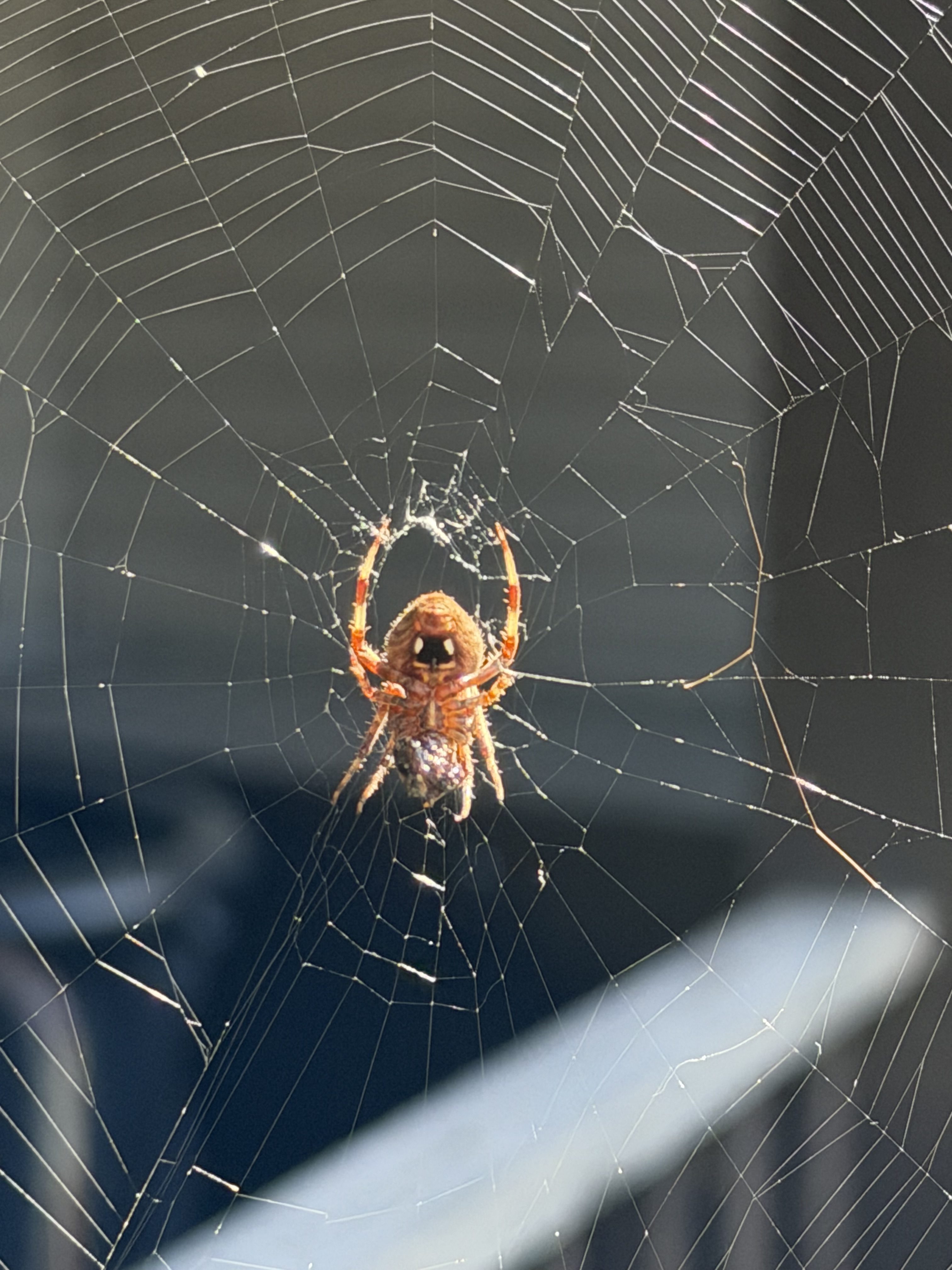
Spiders were doing materials science about 380 million years before we invented the lab coat. A single strand of their silk, thinner than a human hair, beats steel pound for pound and soaks up more energy than Kevlar before it snaps. They make it from protein, at room temperature, with water as the solvent. We need furnaces and petroleum to get close.
Then they use it as a lifeline, a parachute, a nursery, a grocery bag, and arguably a second brain.
So yes, spider webs are a little creepy. They are also some of the best engineering on the planet. Here is what is really going on in that corner of your garage: the silks themselves, why engineers want them, how webs extend a spider’s mind, and why we drape fake cobwebs over everything each October. And since we are a pest control company, what to do when the admiration wears off.
One Spider, Seven Silks
An orb-weaving spider carries up to seven different silk glands, each making a different material for a different job. Think less “spider” and more “walking hardware store.”

| Silk (gland) | Main job | Standout trait |
|---|---|---|
| Major ampullate (dragline) | Web frame, spokes, safety line | The famous one: strong and tough |
| Minor ampullate | Temporary scaffolding while building | Stretchy, doesn’t shrink when wet |
| Flagelliform | Core of the sticky capture spiral | Stretches to 2 to 3 times its length |
| Aggregate | Glue droplets on the capture spiral | Tackiness tuned to humidity |
| Aciniform | Wrapping prey, lining egg sacs | Arguably the toughest silk of all |
| Tubuliform | Outer case of egg sacs | Made only by females |
| Piriform | Attachment discs that anchor threads | Spider superglue |
The recipe changes because the physics changes. Spokes must be stiff enough to carry vibrations and hold the shape. The capture spiral must be soft enough to catch a beetle at full speed without flinging it back out like a trampoline. Same animal, opposite specs.
Rappelling
Most spiders trail a dragline everywhere they go, anchored with piriform “cement” at intervals. It is a climber’s belay rope. Drop off a shelf and the spider controls its descent by braking the line with its legs. That thread you walk into on the porch was probably someone’s safety harness.
Ballooning
Spiderlings, and some small adults, travel by air. They climb to a high point, tip up their abdomen, and let out fine threads until they lift off. Wind helps, but a 2018 study found that Earth’s atmospheric electric field alone can trigger ballooning and provide lift. Spiders have turned up on ships hundreds of miles offshore and in air samples miles high. Charles Darwin noted them landing on the Beagle far out at sea. They are tiny, fearless, and they did not need to book a seat.
Catching prey
Orb webs work as a team effort between silks. Strong spokes carry the load. The stretchy, gluey spiral absorbs the impact and holds on. Some spiders skip glue entirely and use woolly cribellate silk, which snags insects with fine fibrils and electrostatic cling, like a sock from the dryer.

Repairing and recycling
Webs take a beating from wind, rain, prey, and the occasional clueless human. Many orb weavers repair damaged sections or rebuild every night. Here is the clever part: they often eat the old web first. Studies with labeled proteins show the silk is recycled into new silk in well under an hour. Zero waste, zero recycling bins.
Stronger Than Steel? Read the Fine Print
“Spider silk is stronger than steel” is true, sort of, depending on what you mean by “stronger.” Engineers mean at least four different things, and silk wins only some of them.
| Material | Tensile strength (GPa) | Density (g/cm³) | Toughness (MJ/m³) | Stiffness (GPa) |
|---|---|---|---|---|
| Dragline spider silk | ~1.1 | ~1.3 | ~160 | ~10 |
| Darwin’s bark spider silk | ~1.6 | ~1.3 | ~350 | ~12 |
| Kevlar | ~3.6 | ~1.4 | ~50 | ~110 |
| High-tensile steel wire | ~1.5 to 2 | ~7.8 | ~6 | ~200 |
| Structural steel | ~0.4 to 0.5 | ~7.8 | low | ~200 |
Approximate values from published lab measurements; real numbers vary by species, sample, and test.
The four kinds of “strong”
Absolute strength is how much pulling force a given cross-section survives. Here silk is good, not miraculous. It matches decent steel and loses to Kevlar.
Specific strength is strength divided by weight. This is where the headline comes from. Silk is about one-sixth the density of steel, so ounce for ounce it carries roughly four to five times more than high-tensile steel. Kevlar still edges it out.
Toughness is the energy a material absorbs before it breaks. This is silk’s superpower. It combines high strength with real stretch, so it can soak up a hit instead of shattering. Darwin’s bark spider, which strings webs across entire rivers in Madagascar, makes silk roughly seven times tougher than Kevlar.
Stiffness is resistance to bending and stretching. Silk is floppy, about one-twentieth as stiff as steel. Great for a rope. Terrible for a beam. A silk I-beam would sag like a hammock.
One more catch: dragline silk supercontracts. Soak it and it can shrink by up to half its length. Spiders use this to keep webs taut on humid mornings. Engineers building a bridge would rather it didn’t.
What we hope to build
Silk is not going to replace rebar. The realistic targets are places where toughness, light weight, and biocompatibility matter most:
- Medicine: sutures, nerve-repair guides, artificial ligaments, and tissue scaffolds. Silk proteins rarely trigger an immune response.
- Protection: lighter body armor, helmets, and impact layers that absorb energy rather than just resisting it.
- Cables and textiles: lightweight ropes, parachute lines, and high-performance fabrics.
- Composites: silk fibers as a tough reinforcing phase inside other materials, the way straw toughens mud brick.
- Biodegradable replacements: fishing line, packaging films, and fibers that break down instead of becoming microplastics.
Architects are also borrowing the web’s design, not just its material. Modeling work at MIT showed that orb webs survive damage because silk stiffens sharply under heavy load. A broken thread fails locally while the rest of the web holds. That idea, sacrificing one small part to save the structure, is useful for anything that must survive storms or earthquakes.
Why we can’t just farm spiders
Silkworms can be farmed. Spiders cannot. They are territorial, and given roommates, they eat them. A famous cape woven from golden orb-weaver silk took over a million wild-caught spiders and several years to make.
So researchers ferry the silk genes into other hosts: bacteria, yeast, silkworms, plants, and, memorably, goats that produced spider-silk proteins in their milk. Companies such as Spiber, AMSilk, and Kraig Biocraft Laboratories are scaling up production. The hard part is not making the protein. It is the spinning. A spider’s silk duct runs a precise sequence of pressure, acidity, and salt changes that folds liquid protein into a near-perfect fiber in milliseconds. Copying that factory line is the real bottleneck.
Does the strength scale up?
Short answer: not for free.
You may have heard that a web made of pencil-thick silk could stop a jumbo jet. As back-of-envelope math, it works. As engineering, it skips three problems.
- Flaws scale with size. Thin fibers are strong partly because they have few defects. Make a thicker strand and you add more places for a crack to start. This size effect hits nearly every material, from glass to steel.
- Bundles underperform. A cable of many fibers rarely shares the load perfectly. The most strained fibers break first, then their neighbors, and the cable fails below the sum of its parts.
- The square-cube law. Double a structure’s size and its weight grows about eight times while its strength grows about four. A web that is brilliant at spider scale has to fight its own weight at building scale.
Specific strength, at best, stays constant as you scale. In practice it drops. That is why the near-term wins are fibers, films, and composites, not silk skyscrapers.
The Web Is the Brain (Sort Of)
A spider’s brain is about the size of a poppy seed. Yet it builds geometry, tracks prey, and judges what is struggling in its web. How? Some researchers argue it cheats: it stores part of its thinking in the silk.
This is the extended cognition hypothesis, laid out by biologists Hilton Japyassú and Kevin Laland in 2017. The idea is that the web is not just a tool the spider uses. It is part of the spider’s information-processing system, the way your notes app is part of how you remember things.
A sensor the size of a dinner plate
Most web-building spiders see poorly. They “see” through their legs instead. Each leg holds sensitive slit organs that read vibrations traveling down the spokes. From the hub, a spider can tell a trapped fly from a wasp, a falling leaf, wind, or a courting male plucking a carefully coded love note. Get the rhythm wrong and the suitor becomes lunch. Romance is high-stakes in the arachnid world.
Turning up the volume
Here is where it gets nerdy-cool. Spiders can retune their webs. In experiments with the orb weaver Cyclosa octotuberculata, hungry spiders pulled their radial threads tighter, which made the web more sensitive to small prey. Well-fed spiders relaxed the tension and ignored the small stuff. The spider changes what it notices by adjusting its hardware, much like cupping a hand behind your ear.

The feedback loop
Put it together and you get a closed loop between body, brain, and silk:
- The web’s tension and layout shape which vibrations reach the spider.
- The spider’s nervous system interprets those signals and decides how to act.
- The spider’s state, hungry or full, changes how it tunes or rebuilds the web.
- The new web filters the next round of information differently.
The silk handles filtering and amplification. The brain handles decisions. Neither does the whole job alone.
The web remembers
Webs also work as external memory. Existing threads cue the spider’s next move during construction, so the structure guides its own completion. Spiders also return to productive spots and rebuild in patterns shaped by past catches.
Scientists have probed this system in creative ways. Starting in the 1940s, researchers dosed spiders with drugs to see how webs changed. (Caffeine produced some of the messiest webs. Relatable.) In 1973, two garden spiders named Arabella and Anita flew aboard Skylab and, after a rough first attempt, built workable webs in microgravity. Later experiments on the International Space Station showed spiders normally use gravity to orient their webs, and switch to light as a guide when gravity disappears. A brain the size of a poppy seed, improvising in orbit.
Why Webs Haunt Halloween
No Halloween display is complete without fake cobwebs. That is not an accident. Webs sit at the crossroads of biology, folklore, and the calendar.
We may be wired to notice spiders
Fear of spiders is one of the most common phobias, and the unease runs early. A 2017 study at the Max Planck Institute found that six-month-old babies showed a stress response, wider pupils, when shown pictures of spiders, but not flowers or fish. Many researchers think our ancestors who stayed alert to small venomous animals had a survival edge. Your flinch at a web in the face may be very old software.
Webs mean nobody’s home
A web takes time to build and only survives where nothing disturbs it. So a cobwebbed room signals neglect, abandonment, and time passing. That is exactly the mood of a haunted house. Fun fact: “cobweb” comes from the Middle English word coppe, meaning spider. And the cobweb spider family, Theridiidae, includes both the common house spider and the black widow. The messy tangle in your basement corner has a famous cousin.
Webs mean traps
Webs are the original metaphor for deception. In Greek myth, the weaver Arachne out-wove the goddess Athena and was turned into a spider for her trouble, which is why spiders are arachnids today. Sir Walter Scott sealed the idea in 1808: “Oh, what a tangled web we weave, when first we practise to deceive!” Folklore paired spiders with witches, and film did the rest, from giant mutant spiders in 1950s B-movies to Arachnophobia.
Webs peak in October
Here is the scientific twist. Halloween lands right when real webs are most visible. Orb weavers hatch in spring, grow all summer, and reach full adult size in early fall. Mature females build their largest webs just as the season turns. Cool, dewy mornings then coat every strand in droplets. Meanwhile, many male house spiders wander indoors looking for mates. Nature decorates for Halloween before we do.
When Admiration Meets Your Front Porch: Spider Control
Spiders are brilliant engineers and useful pest hunters. That doesn’t mean you want them engineering your living room. Most house spiders are harmless, but webs in every corner, egg sacs in the closet, or a black widow in the garage are a different story.
Signs you have a spider problem
- Webs that reappear within days of removal
- Egg sacs in corners, under furniture, or along window frames
- Frequent spider sightings in basements, garages, crawl spaces, or attics
- Lots of other insects around the home, since spiders go where the food is
- Sightings of venomous species such as black widows or brown recluses
Spider prevention that works
Spider control starts with making your home less inviting:
- Seal entry points. Caulk cracks, repair window screens, and add door sweeps.
- Cut the buffet. Outdoor lights draw insects, which draw spiders. Switch to yellow bug lights or motion sensors.
- Clear the edges. Trim plants away from the foundation and move woodpiles away from the house.
- Declutter. Boxes, piles of clothes, and stored items give spiders quiet places to settle.
- Remove webs and egg sacs. Vacuum them up and empty the vacuum outside. One egg sac can hold hundreds of spiderlings.
When to call a spider exterminator
DIY spider removal helps, but it rarely fixes the cause. If the webs keep coming back, you see venomous spiders, or you have kids and pets to protect, it’s time for professional pest control. A spider infestation is usually a symptom of another pest problem or an open door you haven’t found yet.
That’s where EnviRx Pest Solutions comes in. Our spider control service starts with a full inspection to find where spiders are getting in, where they’re hiding, and what they’re eating. From there, we target the problem at its source: treating entry points and hiding spots, removing webs and egg sacs, and addressing the insects that keep spiders fed. The result is a home that stays spider-free, not just web-free for a week.
Admire the Silk. Leave the Spiders to Us.
Spider silk is tougher than Kevlar, a web can work like part of a brain, and spiders were ballooning across oceans long before we built planes. They deserve our respect. They don’t deserve a lease on your basement.
If your home is collecting more webs than a haunted house this fall, let the pros handle it. Visit goenvirx.com to schedule spider control with EnviRx Pest Solutions today.
Explore more fascinating facts about the natural world at goenvirx.com.
About Rob Greer: Pest Control Expert and Industry Leader
Rob Greer, founder and CEO of EnviRx Pest Solutions, developed a deep respect for nature growing up in a small rural town, where he raised horses and cattle. He began his career in pest control in 2001 and has spent over two decades building and leading pest control operations across the country.
Rob holds a BS in Business Management and is an Associate Certified Entomologist (ACE), a credential held by a small percentage of pest control professionals nationwide. His contributions to the industry include collaboration on the National Pesticide Applicator Certification Core Manual for the EPA and the QualityPro Customer Service Credential Task Force. He is an active member of the Texas Pest Management Association.
The outskirts of Houston is where Rob ran the trails of Huntsville at the Rocky Raccoon 100, and EnvirX’s leadership team lives and works throughout the greater Houston metro. That on-the-ground familiarity with Gulf Coast pest pressures and what residents actually need is what shaped the EnvirX approach…a prescription-based model that diagnoses root causes rather than just treating symptoms.
Leave a Reply