


Published on GoEnvirX.com | Nature Curiosities
If spiders make people scream and wasps make people wail, bees tend to occupy a slightly more sympathetic corner of the insect world. Most people know they’re important. Most people have heard they’re disappearing. And most people, if pressed, would admit they’ve appreciated a bee from a respectful distance without ever wanting one inside their house.
But bees are so much more than the pollinators on the poster. They’re mathematicians. They’re athletes. They’re social animals with a communication system so sophisticated it was once described as the closest thing to language in the non-human animal world. And someone has now built them a robotic home that watches over their queen while they sleep.
So before you swat the next visitor to your garden, give us five minutes. By the end of this article, you might just look at that little fuzzy visitor very differently.
1. They Know Your Face
Here’s a fact that sounds like it belongs to dolphins more than insects: honeybees can recognize individual human faces.
In a study published in the Journal of Experimental Biology, researchers trained bees to associate specific photographs of human faces with a sugar water reward. Beyond learning to distinguish the faces during training. They retained that ability even when shown the photos in different orientations and lighting conditions, and even when tested 48 hours later. Their accuracy? Routinely above 80 percent.
What makes this especially striking is how they do it. Bees process faces holistically (the same way primates do) rather than matching individual features like eyes or noses as a checklist. They perceive the face as a unified whole. Scientists now believe this capacity likely evolved not to recognize humans (obviously), but to help individual bees tell each other apart, which is no small feat in a hive of 60,000.
A bee may not know your name. But if you’ve been visiting its patch of clover regularly, there’s a reasonable chance it knows your face.

2. The Waggle Dance Is a Language
Most animals communicate in the present tense. A bird call warns of a predator right now. A dog’s growl signals discomfort in this moment. Bees do something far stranger: they communicate about places that aren’t here, in directions that aren’t visible, at distances that require abstract representation.
When a scout bee finds a promising food source, she returns to the hive and performs what’s called the waggle dance: a figure-eight movement on the surface of the comb. The angle of the straight run through the center of the figure-eight corresponds precisely to the angle of the food source relative to the sun. The duration of the waggle phase encodes the distance. The vigor of the dance signals the quality of the source.
Other bees watch, follow along, and extract enough information to fly directly to a location they’ve never visited, guided only by a dance they observed in the dark of the hive.
Karl von Frisch, who decoded the waggle dance in the mid-20th century, was awarded the Nobel Prize in Physiology or Medicine for the discovery in 1973. The committee called it one of the most remarkable examples of non-human communication ever documented. He agreed, and spent decades making sure the world understood just how remarkable it was.
3. Their Honeycomb Is a Mathematical Masterpiece
If you asked an engineer to design a container that maximizes storage space, minimizes material used, and maintains structural integrity under load, they would probably spend considerable time arriving at something a bee colony figured out millions of years ago.
The hexagonal cell of a honeycomb is the most efficient way to divide a flat surface into equal units with the least total perimeter. Pack circles together and you waste space at the gaps. Use squares or triangles and you use more material for the same storage area. The hexagon hits the mathematical sweet spot, and bees build it with wax they produce themselves, at enormous metabolic cost.
For every kilogram of wax a colony produces, the bees consume roughly six to eight kilograms of honey to generate the energy needed. Given that cost, the aesthetically pleasing efficiency of the hexagonal design is a matter of colony survival. The bees also build the cells at a slight upward tilt to prevent honey from flowing out before it’s capped, and they maintain the interior temperature of the brood nest to within half a degree Celsius of 35°C, around the clock, year-round.
Mathematicians formally proved the hexagonal honeycomb is the optimal solution — known as the Honeycomb Conjecture only in 1999. Bees had been living the proof for tens of millions of years.
4. Their Aerobic Capacity Rivals Elite Athletes
Bees are small. Their wings are smaller. And yet a foraging honeybee, loaded with pollen, routinely flies at speeds up to 24 kilometers per hour, beats its wings around 230 times per second, and covers distances that can exceed 13 kilometers in a single foraging trip. Multiple times a day.
Measured by oxygen consumption relative to body weight, bees have one of the highest VO₂ max values of any animal on earth. This is a metric normally associated with elite endurance athletes like Tour de France cyclists or competitive sled dogs. Their flight muscles, which make up a substantial portion of their body mass, are among the most metabolically active tissues in the animal kingdom. And unlike most insects, which rely on the temperature of their environment to warm up for flight, bees can shiver their flight muscles to generate heat internally, allowing them to fly in temperatures that would ground other insects entirely.
They also do this while simultaneously navigating, communicating, and foraging. The aerobic demands of a single foraging flight would, scaled to human size, be roughly equivalent to running a marathon at full sprint…before breakfast.
5. The Hive Has a Memory the Individual Doesn’t
A single bee lives for about six weeks in summer. She carries no institutional knowledge from previous seasons, no awareness of historical routes or past crises. And yet the colony she’s part of can adapt, remember, and solve problems across timescales that far exceed any individual life.
This is because the hive functions as a superorganism, i.e. a collective intelligence distributed across thousands of individuals. Forager bees share information through the waggle dance. Scout bees debate the merits of potential new nest sites through a process that looks remarkably like voting, with individual bees recruiting others to their preferred location until a quorum is reached. The colony takes reaction to the level of deliberation.
Researchers have found that bee colonies can be trained to associate colors, shapes, and even odors with rewards, and that this learned information persists even as the individual bees who learned it die and are replaced. The colony, in other words, knows things that no individual bee within it knows. The knowledge lives in the system, instead of the individual… and it keeps going.
6. A Queen Is Made
Every egg a queen lays has the potential to become either a worker or a new queen. The difference has nothing to do with genetics. It’s entirely about diet.
A larva destined to become a worker is fed a mixture of honey, pollen, and royal jelly for the first few days, then transitions to a simpler diet of honey and pollen. A larva destined to become a queen is fed royal jelly (a protein-rich secretion from the glands of nurse bees) exclusively, for her entire larval development.
That dietary difference triggers an entirely different developmental pathway. The queen larva develops functional ovaries. Her reproductive organs mature. Her life expectancy extends from six weeks to five or more years. She becomes, in every physiologically meaningful sense, a different animal than her genetically identical sisters, all from the same egg, shaped entirely by what she ate in her first week of life.
The colony controls this process with extraordinary precision. When a queen is lost, aging, or failing, nurse bees will sometimes select a young worker larva such as one that hasn’t aged out of the window when the switch is still possible, and begin feeding it exclusively royal jelly. They are, in effect, rebuilding their queen from scratch from a larva that was already on its way to becoming something else entirely.
7. Bees Are Older Than Flowers, But Not by Much
The relationship between bees and flowering plants is so tight that it’s easy to assume they evolved together, hand in glove, from the very beginning. The reality is slightly more complicated, and considerably more interesting.
Bees are thought to have evolved from wasp ancestors roughly 130 million years ago, around the same time that flowering plants began their dramatic radiation across the planet. Before flowers, wasps were hunting insects; bees essentially pivoted to hunting pollen instead, an evolutionary dietary shift that reshaped terrestrial ecosystems.
The co-evolution that followed is one of the most consequential in the history of life on earth. Flowers evolved colors, shapes, scents, and nectar guides (ultraviolet patterns invisible to humans but brilliantly visible to bees) specifically to attract pollinators. Bees evolved specialized body structures, branched hairs that catch and hold pollen more efficiently than smooth surfaces, corbiculae (pollen baskets) on their hind legs, and color vision morphed precisely to the wavelengths that flowers advertise.
The result is that roughly 80 percent of all flowering plant species now depend on animal pollinators to reproduce, and bees are the single most important group among them. Neither party planned this. It emerged from 130 million years of mutual pressure, mutual reward, and mutual dependency.
8. A Bee Sting Is a One-Way Trip (for the Bee)
When a honeybee stings a mammal, something unusual happens: the barbed stinger lodges in the skin, and as the bee tries to pull free, the entire venom apparatus including the stinger, the venom sac, and a cluster of associated muscles and nerves, tears away from the bee’s abdomen. The bee flies off. The apparatus stays behind, still pumping venom by muscular reflex, for up to a minute after separation.
The bee, for her part, will die within hours.
This is not a bug, It’s a feature, calibrated by evolution to the specific challenge of defending a hive against large mammals. The detached venom apparatus continues delivering venom far more effectively than the bee ever could by staying in place, and as it pumps, it releases alarm pheromones that recruit other bees to the threat location. The individual sacrifices herself; the defense intensifies.
Importantly, this is specific to honeybees. Most other bee species such as bumblebees, mason bees, and sweat bees have smooth stingers and can sting multiple times without consequence to themselves. And the vast majority of bee species, the roughly 20,000 species that exist worldwide, are solitary rather than colonial, have no hive to defend, and therefore almost never sting at all.

9. They Navigate by Polarized Light and Magnetic Fields
Bees have something arguably more impressive than fancy human GPS.
Honeybees can navigate using the position of the sun and crucially, they can do this even when the sun is obscured by clouds, because they detect the pattern of polarized light in the sky, which reveals the sun’s position regardless of cloud cover. They also maintain an internal time-sense, updating their mental map of the sun’s arc throughout the day so that a direction learned in the morning can still be communicated accurately in the afternoon.
Recent research has added another layer: bees appear to have magnetoreception which is the ability to sense the Earth’s magnetic field. Bees use this magnetoreception to orient the combs within the hive and to calibrate their navigation over longer distances. Tiny particles of magnetite, the same mineral used in the earliest human compasses, have been found in the abdomens of honeybees.
They also learn landmarks: distinctive trees, buildings, and terrain features that they use as waypoints on familiar routes. A foraging bee isn’t flying blind, she’s running a multi-system navigational suite that integrates solar position, polarized light, magnetic field, and spatial memory simultaneously, all in a brain smaller than a sesame seed.

10. Someone Built Them a Robotic Home That Watches Over Their Queen
For most of human history, the only way to know whether a bee colony was healthy was to open the hive and look which unfortunately is a process that’s disruptive, labor-intensive, and requires close inspection of tens of thousands of bees under conditions they find, understandably, stressful.
That’s changing.
A Florida community recently became the first master-planned community to install Beewise’s automated BeeHome system: a fully autonomous robotic hive that uses sensors, AI, and robotics to monitor colony health around the clock, without anyone having to open a lid. The system tracks queen activity, egg production, and infestations from varroa mites (one of the primary drivers of colony collapse) in real time. When a threat is detected, it can respond automatically by moving bees to a different section of the unit and adjusting temperature to neutralize the problem, all without human intervention.
Beewise’s managing director has noted the technology is already operating across hundreds of thousands of acres of agricultural land nationwide. The company reports a 70 percent reduction in colony collapse among monitored hives.
Researchers are also developing sensor platforms that detect queen absence through temperature and humidity differentials inside the hive, achieving over 99 percent accuracy non-invasively, with no disruption to the colony. And a wireless sensor system validated at USDA-ARS facilities in North Dakota monitors CO₂ levels, humidity, and temperature in real time to detect bee stress before it becomes crisis.
The hive of the near future will know when something is wrong before the beekeeper does. It will summon help. It will, in some cases, fix the problem itself. The bees are still doing what they’ve always done. The technology around them is just finally catching up.
A Little More Respect (From a Safe Distance)
Bees have been dancing directions, optimizing geometry, and running collective intelligence operations since long before any of it had names. They are, by almost any measure, among the most extraordinary animals on the planet, and they are under genuine pressure from habitat loss, pesticides, disease, and climate change.
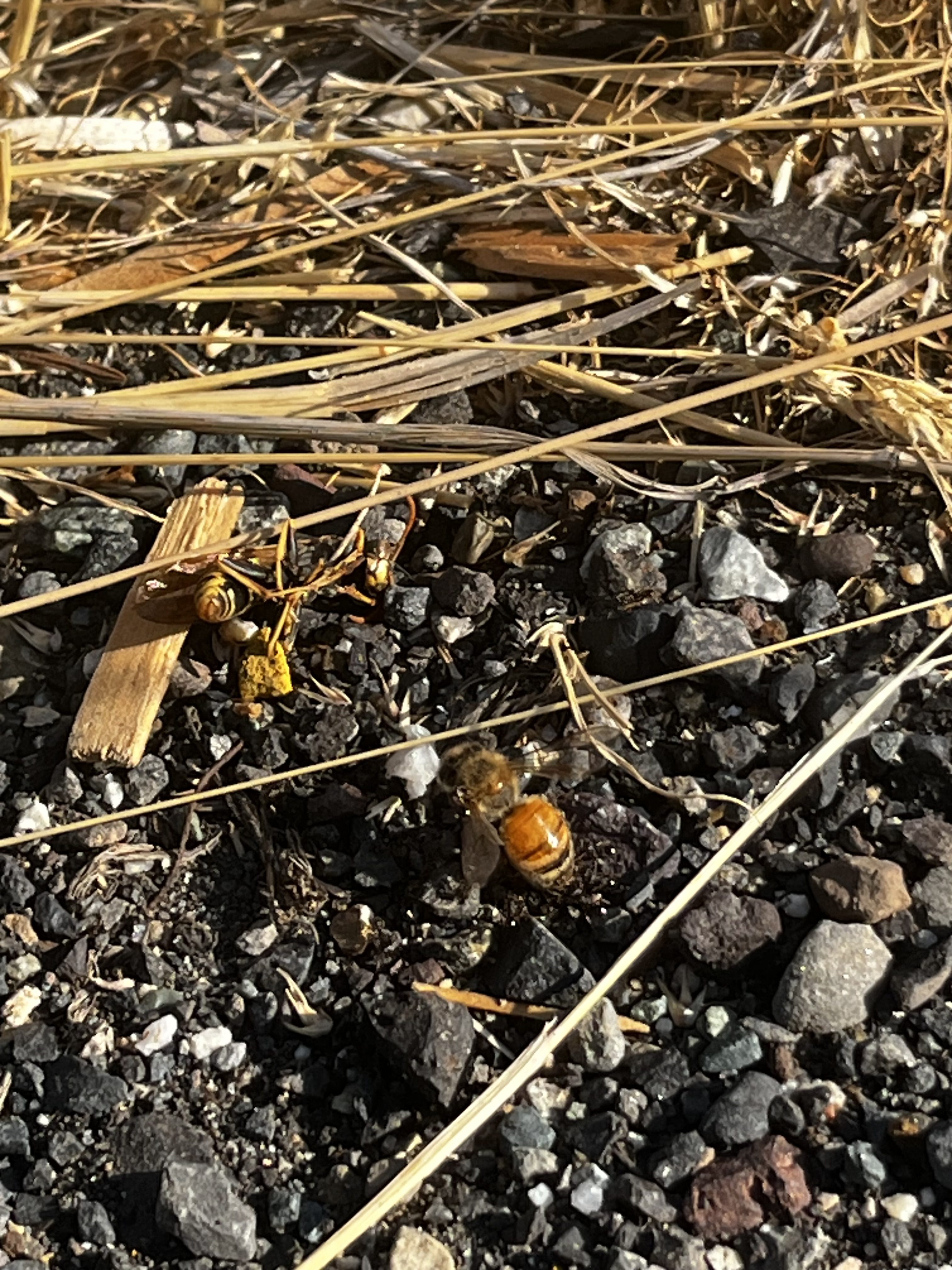
That said, appreciation for bees doesn’t mean you have to leave with their more aggressive relatives that build active nests under your eaves.
Start Your Environmentally Conscious Pest Prescription Today
If you’ve found pest activity around your home and aren’t sure whether it’s something to monitor or something to address, schedule an inspection with the EnviRx Pest Solutions team. We’ll help you figure out the right approach that protects your family without losing sight of the extraordinary role these insects play in the world just outside your walls.
Explore more fascinating facts about the natural world at goenvirx.com.
About Rob Greer: Pest Control Expert and Industry Leader
Rob Greer, founder and CEO of EnvirX Pest Solutions, developed a deep respect for nature growing up in a small rural town, where he raised horses and cattle. He began his career in pest control in 2001 and has spent over two decades building and leading pest control operations across the country.
Rob holds a BS in Business Management and is an Associate Certified Entomologist (ACE), a credential held by a small percentage of pest control professionals nationwide. His contributions to the industry include collaboration on the National Pesticide Applicator Certification Core Manual for the EPA and the QualityPro Customer Service Credential Task Force. He is an active member of the Texas Pest Management Association.
The outskirts of Houston is where Rob ran the trails of Huntsville at the Rocky Raccoon 100, and EnvirX’s leadership team lives and works throughout the greater Houston metro. That on-the-ground familiarity with Gulf Coast pest pressures and what residents actually need is what shaped the EnvirX approach…a prescription-based model that diagnoses root causes rather than just treating symptoms.
Leave a Reply