


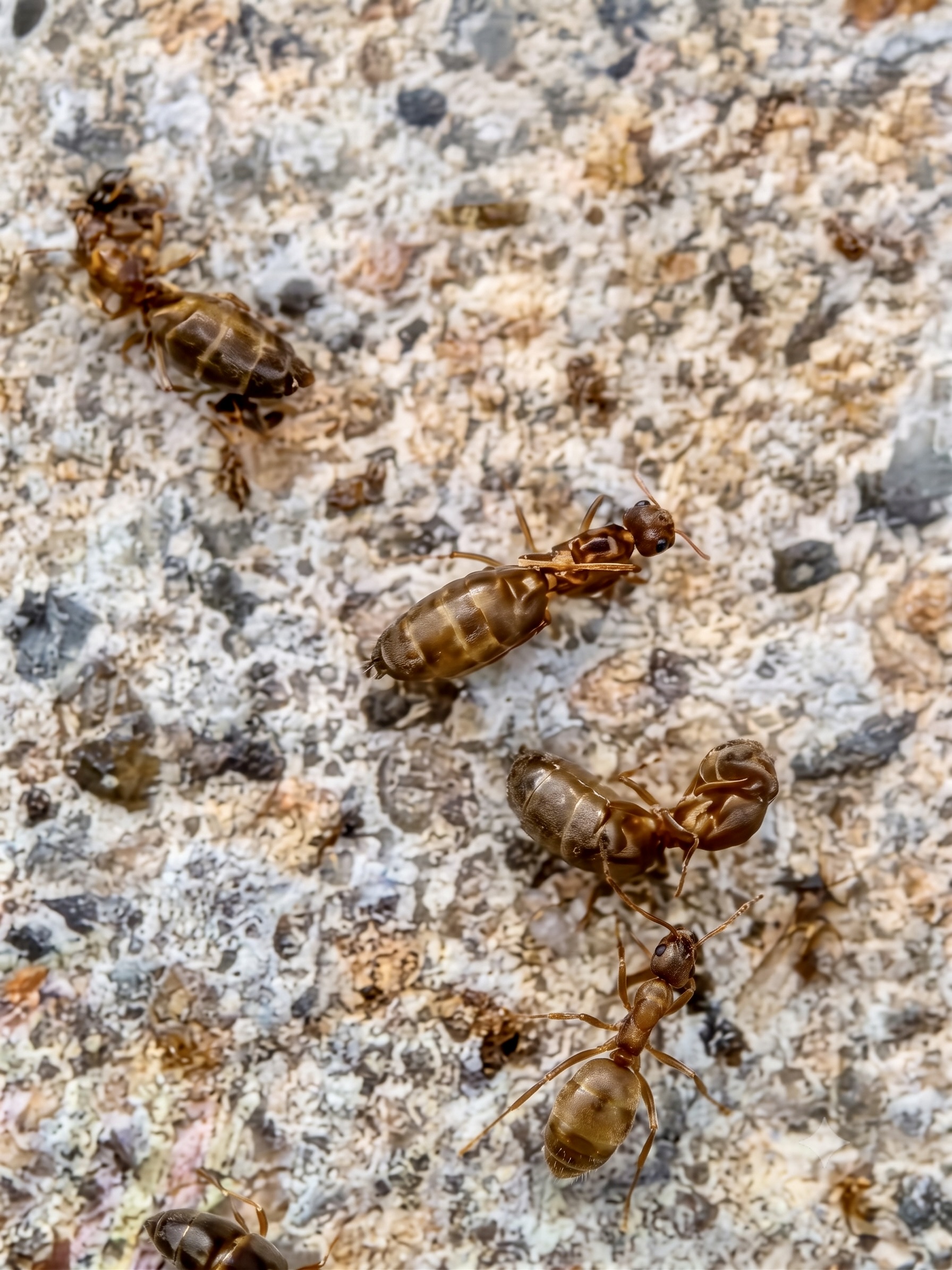
Why Are There Clouds of Ants Around Your Streetlights? Meet the Tawny Crazy Ant
If you’ve walked outside on a warm evening in Katy lately and found yourself doing an involuntary interpretive dance under the streetlight, e.g. swatting, ducking, wondering if you’ve wandered into a horror movie, you’re not imagining things, and you’re not alone. Over the past few weeks, our sales team has fielded a noticeable uptick in calls from homeowners describing the same scene: a shimmering, twitching halo of tiny winged insects circling every lamppost, porch light, and garage fixture on the block after dark.
We sent the question to our in-house entomologist, and one of the culprits has a name almost as memorable as its behavior: the tawny crazy ant (Nylanderia fulva).
Wait, Ants Fly?
Some of them, some of the time. Most of the ants marching across your patio are wingless worker ants. These are sterile females whose entire job description is “find food, defend the colony, repeat.” But once a colony matures and conditions are right, it invests energy into producing a special generation of reproductive ants called alates. These are winged, fertile males and virgin queens whose one job is to leave the nest, mate in midair during what’s called a nuptial flight, and, for the lucky, surviving queens, found a brand-new colony somewhere else.
Tawny crazy ants mostly get around by “budding,” where a queen and a group of workers simply split off and walk to a new spot, which is a big part of why their colonies can spread so explosively fast across a yard or neighborhood. But they still produce alates periodically for longer-distance dispersal and genetic mixing, and when a mature colony (or several nearby colonies) times it right, you get a synchronized flight event, which is exactly what’s been showing up under Katy’s streetlights.
Other ants that you might see flying in their alate form around Houston suburbs include carpenter ants and false honey ants.

So Why Katy? Why Now? Why the Streetlights Specifically?
Three things are converging, and none of them are your fault:
1. Tawny crazy ants are extremely well established in the Houston area. This species arrived on the Gulf Coast in the early 2000’s and has since become one of the dominant nuisance ants across Harris, Fort Bend, and surrounding counties. Katy’s mix of established landscaping, mulch beds, irrigation, and mature tree canopy is close to ideal habitat. These ants love moist, shaded ground debris, leaf litter, potted plants, and the soil under structures.
2. Our summer weather is the trigger. Nuptial flights are cued by a combination of warm nighttime temperatures, high humidity, and calm winds. This is basically every muggy Houston evening from late spring through fall. Recent rain can accelerate things further by softening soil, making it easier for new queens to dig in once they land.
3. Ants are phototactic; meaning they’re drawn to light. Just like moths that dive-bomb your porch bulb. Artificial light, especially the cooler, shorter-wavelength light common in LED street lamps, seems to be an especially strong lure for swarming insects. Alates that would otherwise disperse across a dark landscape instead funnel toward the brightest point around (your streetlight) creating that dense, swirling cloud effect that’s been catching everyone’s attention.
The good news, if there is any: a wild, twitchy cloud of alates around a lamppost is a temporary phenomenon, not an active infestation of your home. The less-good news: it’s a pretty reliable sign that there are one or more established tawny crazy ant colonies within easy walking distance of that light. Statistically, this means they are within easy walking distance of your foundation.
Should You Be Worried?
Tawny crazy ants aren’t a structural threat like termites, and they don’t bite or sting the way fire ants do. But they’ve earned a reputation among Texas homeowners for good reason:
- They come in overwhelming numbers. Unlike fire ants, which form discrete mounds, tawny crazy ant colonies can reach staggering densities across an entire property, forming shifting “supercolonies” without a single obvious nest.
- They’re drawn to electronics. For reasons entomologists still debate, tawny crazy ants are notorious for nesting inside outdoor electrical equipment, AC units, junction boxes, and irrigation controllers, and even sometimes causing short circuits.
- They displace other insects, including fire ants. That might sound like a silver lining, but a tawny crazy ant takeover trades one nuisance for a much larger one.
- They’re difficult to eliminate with DIY products. Because colonies are so large, diffuse, and multi-queened, over-the-counter sprays and baits typically knock back only a fraction of the population before it rebounds.
Protecting Your Home and Yard
Here’s what our entomology team recommends while activity is high:
- Reduce moisture and debris near your foundation. Trim back mulch depth, clear leaf litter, and fix any drainage issues or standing water. Tawny crazy ants thrive in damp, sheltered microhabitats.
- Seal obvious entry points around utility lines, weep holes, and gaps where exterior walls meet the ground.
- Inspect outdoor electrical boxes and irrigation equipment periodically, since these are prime nesting real estate.
- Skip the lamppost battle. Spraying insecticide at a streetlight swarm won’t meaningfully reduce the population. Those alates are already leaving their colonies for good, and the fight that matters is happening underground, at the source.
- Have the actual colony(s) identified and treated at the source. Because tawny crazy ant colonies are so extensive and often span multiple properties, professional-grade, targeted treatment plans are far more effective than any single homeowner spraying their own yard in isolation.

The Bottom Line
That eerie halo of ants swirling around your neighborhood’s streetlights is a very normal (if slightly unsettling) ant mating ritual, amplified by our climate, our landscaping, and our light fixtures. But it’s also a good nudge to check whether tawny crazy ants have quietly set up shop closer to home than you’d like.
If you’ve noticed the swarms or trails of erratic, fast-moving ants around your patio, AC unit, or flower beds, our team would be glad to send someone out to take a look, identify exactly what’s going on, and put together a treatment plan tailored to your property. No pressure, just peace of mind (and a lot fewer ants doing laps around your porch light). For other amazing facts about ants, click here.
About Rob Greer: Pest Control Expert and Industry Leader
Rob Greer, founder and CEO of EnvirX Pest Solutions, developed a deep respect for nature growing up in a small rural town, where he raised horses and cattle. He began his career in pest control in 2001 and has spent over two decades building and leading pest control operations across the country.
Rob holds a BS in Business Management and is an Associate Certified Entomologist (ACE), a credential held by a small percentage of pest control professionals nationwide. His contributions to the industry include collaboration on the National Pesticide Applicator Certification Core Manual for the EPA and the QualityPro Customer Service Credential Task Force. He is an active member of the Texas Pest Management Association.
The outskirts of Houston is where Rob ran the trails of Huntsville at the Rocky Raccoon 100, and EnvirX’s leadership team lives and works throughout the greater Houston metro. That on-the-ground familiarity with Gulf Coast pest pressures and what residents actually need is what shaped the EnvirX approach…a prescription-based model that diagnoses root causes rather than just treating symptoms.
Leave a Reply